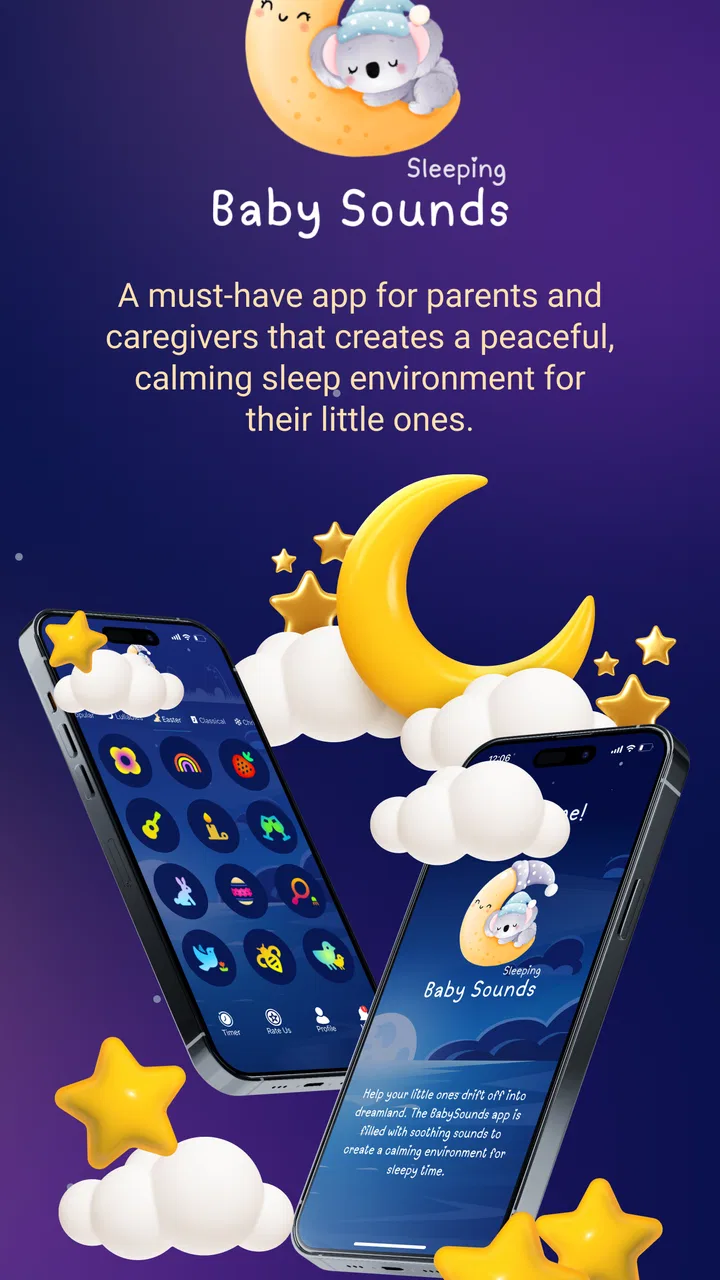
Baby Sleep Sounds: White Noise
- 4.1
- Rating
- 50.00K
- Installs
- Free
- Price

 Analysis by App-foxy
When a baby is overtired, the smallest interruption can feel enormous. I tried Baby Sleep Sounds: White Noise from OddLabs with that familiar goal in mind: create a steady background sound without turning bedtime into another complicated task. It is a free parenting app for everyone, focused on white noise, sleep sounds, and a calmer nursery atmosphere. My overall impression is that its value depends less on novelty and more on whether it fits the way your household handles phones, speakers, and connectivity at bedtime.
The app has reached more than 50K installs and holds a 4.1 average from roughly 123 ratings, with about 26 written reviews. Those figures suggest a useful but not universally perfect experience, which matches my own view. It can be a practical sleep aid for parents who want a simple sound source, but it is not a replacement for a full baby-monitoring setup, a carefully controlled nursery routine, or a dedicated sound machine when reliability is the highest priority.
How connectivity changes the bedtime experience
I find connectivity matters most before the baby is settled: a quick test in the room can show whether the chosen sound starts and continues smoothly on your usual setup. If it does, I can keep the bedtime routine simple; if it falters, I would switch to a dependable backup rather than troubleshooting beside the crib. That preparation also makes the next question clearer: how to hand the phone and routine over to another caregiver.
You May Also Like

 Blood Strike: 2.5 Anniversary
Blood Strike’s Loadouts Turn Every Drop Into a Tactical Gamble
A close look at Blood Strike’s custom loadouts: how fast access to signature weapons reshapes its battle royale rhythm, rewards preparation, and narrows the gap between fights.

 Pandora - Music & Podcasts
Pandora’s Music Is Easy to Start, but Harder to Recover
Pandora’s strength is its low-effort path from a seed to a station. Its weak spot is how much confidence it asks you to place in connection, setup, and quiet recovery.

 8 Ball Pool
 Is Built on Rivalries, Rematches, and Routine
A close look at the rivalries, rematches, shared routines, and unanswered safety questions that turn a quick pool match into a persistent mobile community.

 Samsung Music
’s Quiet Strength Is Playing What You Already Own
Its reach comes less from spectacle than from dependable access to a personal library. That simplicity is both the app’s strongest retention engine and its ceiling.

 AccuWeather: Weather Radar
AccuWeather Review: A Quick, Clear Forecast for Everyday Decisions
For everyday plans, the best forecast is the one you can understand quickly. AccuWeather makes rain timing, radar, and local conditions easy to act on, with a few trade-offs.

 Hill Climb Racing
Why Hill Climb Racing Still Turns Crashes Into One More Run
A tiny car, a bumpy hill and one more upgrade: Hill Climb Racing keeps resurfacing because its simple chaos makes every near-miss feel personal.
More From Our News Desk



The first setup is easy, but the phone becomes part of the routine
The most important thing to understand is that this is an app rather than a separate nursery device. That gives you flexibility: you already have a phone, you can move it between rooms, and you do not need to buy another piece of equipment just to try a calming sound. At the same time, the phone becomes part of the sleep arrangement. Its battery, notifications, speaker position, and network conditions all matter more than they would with a traditional white-noise machine.
I would start by opening the app before the baby is already upset. That gives me time to choose a sound, set the phone where it will not be knocked over, lower the volume, and deal with anything that might interrupt the session. This small change makes a noticeable difference. A sound app is most useful when it removes decisions from the difficult part of bedtime, not when I am searching through menus while a child is crying.
The free entry point is appealing for families who want to test the idea without committing to hardware. There are also in-app purchases ranging from $0.99 to $19.99 per item, so I would pay attention to what is available before treating the free version as a complete long-term solution. The sensible approach is to use the no-cost experience first, see whether your child responds to the available sounds, and only then decide whether spending money adds enough convenience or variety.
What happens when the connection is weak?
Connectivity is the part I would think about most carefully. A sound app may need a network connection during some stages of use, such as opening content or loading parts of the experience, but I would not assume that every sound remains available without a connection. The practical lesson is simple: test the exact bedtime routine in the room where you plan to use it, including any moment when your phone has weak reception or your home network is unavailable.
This matters particularly in bedrooms far from the router, holiday accommodation, older homes with thick walls, or nighttime situations where mobile data is limited. If the app opens and plays the chosen sound reliably in your normal environment, connectivity may fade into the background. If it hesitates at the wrong moment, the convenience of using a phone can disappear quickly.
I would prepare before settling the baby. Open the app, select the sound, and let it run for a few minutes while you are still awake. If the audio starts immediately and continues as expected, you have a better chance of avoiding a late-night scramble. If it requires repeated loading or behaves unpredictably, keep a non-network-dependent alternative nearby rather than discovering the problem at two in the morning.
Using it in a mobile household
The app makes the most sense for parents who move between rooms or locations. A phone can follow a nap from the nursery to a stroller, a guest room, or a relative’s house. That is more adaptable than a fixed sound machine, especially during travel. I can also see the appeal for new parents who do not yet know whether their baby prefers a steady hiss, a softer ambient sound, or another style in the app’s selection.
However, portability creates trade-offs. The phone may be needed for a call, a navigation app, a baby-monitoring function, or a charging cable. If another family member takes it, the sound goes with it. A dedicated machine avoids that conflict because it has one job. For a household where the phone is constantly shared, the app is convenient only when someone remembers to protect its role during sleep.
There is also a difference between using the phone’s built-in speaker and sending audio to another device. I would not assume that every wireless speaker or accessory will behave identically. Pairing can introduce another failure point, and a speaker in another room may make it harder to judge the actual volume near the baby. The simplest arrangement is often the most dependable: one prepared phone, placed safely away from the crib, with the sound kept gentle and consistent.
A realistic evening workflow
Imagine a typical evening: the baby has been fed, the lights are low, and the final change has taken longer than expected. Instead of opening the app only after the crying starts, I would launch it while preparing the room. I would choose one sound and avoid switching repeatedly once the baby is nearly asleep. I would then put the phone on a stable surface outside the sleeping area, check that the display and notifications will not become a distraction, and leave the app alone.
That workflow highlights one of the app’s less obvious strengths. It can become a repeatable cue rather than a rescue button. The sound itself may not make a child sleep, but using the same preparation steps each evening can reduce the number of variables around bedtime. The app is therefore more useful as part of a routine than as a promise of instant sleep.
For naps away from home, I would prepare even earlier. A hotel room or family visit is exactly where network conditions, charging access, and unfamiliar noise can complicate things. Testing the app before the nap begins tells me whether the phone can do the job in that location. If it cannot, I still have time to switch to another option instead of relying on a rushed download or a weak signal.
Failure points and sensible recovery
The main weakness of a phone-based sleep tool is that several ordinary phone problems can become bedtime problems. The battery may be low, another app may compete for audio, a notification may wake the screen, or the connection may be unreliable. None of these issues says much about the sound quality itself, but they affect whether the app feels dependable when parents need it most.
My recovery plan would be deliberately boring. Before bedtime, charge the phone or place it where it can safely remain connected to power, then start the selected sound while the baby is still calm. If playback stops, I would avoid repeatedly changing sounds and instead restart the same choice once. Consistency is more valuable than experimenting during a difficult moment.
If the app does not behave as expected, I would first check the basics: whether another audio session is active, whether the phone is muted, whether the volume is appropriate, and whether the connection is stable. Then I would close and reopen the app if necessary. If the same problem keeps appearing, that is the point where a dedicated sound machine or a sound source that you know works without network access becomes the better tool.
This is also why I would not use it as the only sleep backup during travel. The app is inexpensive to try, but a backup does not have to be elaborate. A familiar physical sound machine, a previously tested alternative, or even a well-established household routine may be more reassuring than depending on a single phone. Reliability matters more than having the largest sound selection.
Being careful with data and distractions
A data-conscious approach starts with using the app intentionally rather than leaving the phone online and active for every sleep period without thinking about it. If your connection is metered, check how the app behaves during setup and avoid unnecessary browsing while you are trying to start a sound. I would also use home Wi-Fi for initial exploration when possible, then test the actual bedtime arrangement instead of assuming it will behave the same way everywhere.
The phone itself deserves attention. Turn off distracting notifications, use a stable screen setting, and keep the device far enough from the crib that it cannot become a loose object or an invitation for grabbing. I would not place it under bedding or inside the sleeping space simply to make the sound louder. The safest useful position is one that provides an audible, gentle background without putting the device within reach.
Volume is another area where restraint helps. White noise should not become the loudest event in the room. I prefer starting lower than expected and raising it only enough to soften household sounds. A phone speaker can sound sharper at high volume, and a connected speaker can be more powerful than needed. The app gives you a sound source; it does not decide the correct placement or listening level for your nursery.
There is a privacy-related practical habit I would recommend even without making assumptions about the app’s policies: review the permissions and device settings shown on your own phone, and avoid granting access that does not seem relevant to how you intend to use it. This is good practice for any parenting app. It also keeps the experience focused, rather than turning a simple sleep aid into a collection of alerts and background activity.
How it compares with familiar alternatives
Compared with a dedicated white-noise machine, the OddLabs app is cheaper to try and easier to carry. It also lets you discover whether your baby responds to this kind of sound before buying hardware. The dedicated device wins when you want a single-purpose control panel, predictable startup, and no competition with calls or other phone tasks.
Compared with general music or video services, a purpose-built parenting app feels more focused. You are less likely to end up choosing songs, watching a bright screen, or dealing with unrelated recommendations. On the other hand, a general audio service may already be part of your household routine and may offer stronger control over downloads or playback in your particular setup. The right choice depends on whether simplicity inside the app matters more than the flexibility of a service you already know.
Compared with a physical household sound such as a fan, the app is more portable and easier to change between rooms. A fan may be familiar and independent of the phone, but it can introduce its own safety and temperature considerations, and it may not be practical everywhere. I see Baby Sleep Sounds as a middle option: more adaptable than hardware, more focused than a general media app, but still dependent on a phone-based routine.
Who will appreciate it most?
I think it is best for parents who want to experiment gently, travel often, or need a flexible sound source for occasional naps. It is also useful for families who do not want to purchase a separate machine before knowing whether white noise belongs in their bedtime routine. The everyone age rating makes it broadly accessible as an app, while the parenting context means adults should still decide where and how it is used around a baby.
It may be a particularly good fit for a household with several sleep locations. If the baby naps in different rooms, or if grandparents sometimes handle bedtime, a phone-based option can be easier to carry than a dedicated unit. The key is to teach everyone the same workflow: choose the sound in advance, keep the phone safely positioned, use a modest volume, and have a backup if the connection or battery becomes a problem.
I would skip it as a primary solution if your main requirement is guaranteed operation without connectivity, a dedicated physical control, or a device that never competes with your personal phone. I would also avoid making it the center of a complicated sleep strategy. If your child dislikes these sounds, or if the app’s available choices do not suit your routine, paying for additional items will not necessarily solve the underlying issue.
Version, cost, and long-term practicality
The current version is 7.2.4 and it supports Android devices running version 5.0 or later. That makes it accessible to many older phones, which is useful if you have an unused device available for the nursery. An older spare phone can reduce interruptions to your main phone, though I would still check its battery condition, speaker behavior, and safe placement before trusting it overnight.
Because the app is free to install, the initial decision is low risk. The more important question is whether the free experience remains useful for your particular baby and routine. The in-app purchase range is wide enough that I would not buy simply because a difficult evening makes every extra option seem attractive. First identify what is missing: a preferred sound, easier access, or a smoother routine. Spend only if the purchase addresses that specific problem.
The developer is OddLabs, and the app was released on June 29, 2023. I would treat the version number as a reason to keep the app updated when convenient, especially if it is becoming part of regular bedtime use. Still, an update does not remove the need for a practical test after installation. The real question is always whether the current phone, room, speaker, and connection work together reliably.
My connectivity verdict
After looking at the app through the lens of real household use, I see Baby Sleep Sounds: White Noise as a useful convenience rather than a complete nursery solution. Its strongest point is flexibility: it gives parents a low-cost way to try calming audio, move between rooms, and build a repeatable bedtime cue around a device they already own.
Its weak point is the same thing that makes it convenient. The phone and its connection become part of the chain. A low battery, a competing audio task, a weak network, or an unexpected interruption can undermine the experience at exactly the wrong time. I would therefore test it in advance, keep the volume modest, protect the phone from becoming a distraction, and maintain a backup for nights when dependability matters more than convenience.
For my recommendation, I would suggest trying it if you want a simple parenting app and are comfortable checking the technical basics before sleep. I would not promise that it will settle every baby, and I would not choose it over a dedicated machine when independent, always-ready operation is essential. Used with realistic expectations, though, it can earn a place in a bedtime routine without demanding much money or equipment. Its best role is a prepared, portable sound cue—not a substitute for the rest of a safe and consistent sleep environment.
FAQs for Baby Sleep Sounds: White Noise
01What is Baby Sleep Sounds: White Noise used for?
Baby Sleep Sounds: White Noise is designed to create a calming background environment that may help babies and young children settle down for naps or nighttime sleep. It typically offers continuous sounds such as white noise, gentle shushing, rain, nature ambience, or lullabies. The app is intended as a sleep aid and should be used alongside a consistent bedtime routine, not as a replacement for one.
02Does Baby Sleep Sounds: White Noise work offline?
Many sound apps allow users to play at least some audio without an internet connection, which is useful during travel or when a phone is placed in airplane mode. However, availability can depend on the specific sound library and whether tracks must be downloaded first. Before relying on it at bedtime, test the selected sounds offline and confirm that playback continues after the screen is locked.
03Is Baby Sleep Sounds: White Noise safe for babies?
The app itself can be convenient, but safe use depends on volume, placement, and duration. Keep the phone or speaker well away from the baby’s crib, avoid placing any device inside the sleep area, and use the lowest volume that is effective. Parents should also follow current safe-sleep guidance and monitor the child. The app should never be used to mask crying or replace supervision.
04Can I set a timer or keep the sounds playing all night?
Sleep sound applications commonly include a timer, looping playback, or both, allowing parents to choose whether audio stops after a selected period or continues throughout the night. The exact controls may vary by version and device. A timer can reduce unnecessary battery use, while continuous playback may suit babies who wake easily when the background sound suddenly stops. Check the playback settings before bedtime.
05Does Baby Sleep Sounds: White Noise contain ads or require payment?
The app’s business model may include free sounds supported by advertising, optional in-app purchases, or a premium subscription that unlocks additional audio and removes ads. Pricing and available features can change between Android and iOS versions. Review the store listing and in-app purchase screen before downloading, especially if the app will be used overnight, since advertisements or upgrade prompts may affect convenience.
Pros
- Wide selection of calming white-noise and sleep sounds
- Simple controls make it easy to start a bedtime session
- Useful timer helps stop playback automatically
- Can support consistent sleep routines for babies
- Suitable for naps
- nighttime sleep
- and soothing fussy moments
Cons
- Some sounds or features may require in-app purchases
- Continuous playback can drain the device battery
- Audio may not suit every baby’s individual preferences
- Requires careful volume control to protect sensitive hearing
- Background playback may be limited by certain device settings

Baby Sleep Sounds: White Noise
Gallery